
From waste to material
To investigate the potential of cocoa husks, an agri-food by-product donated by Kaicao, as a raw material for new biomaterials applied to fashion design.

Three biomaterials derived from cocoa husks, applied to experimental fashion design.
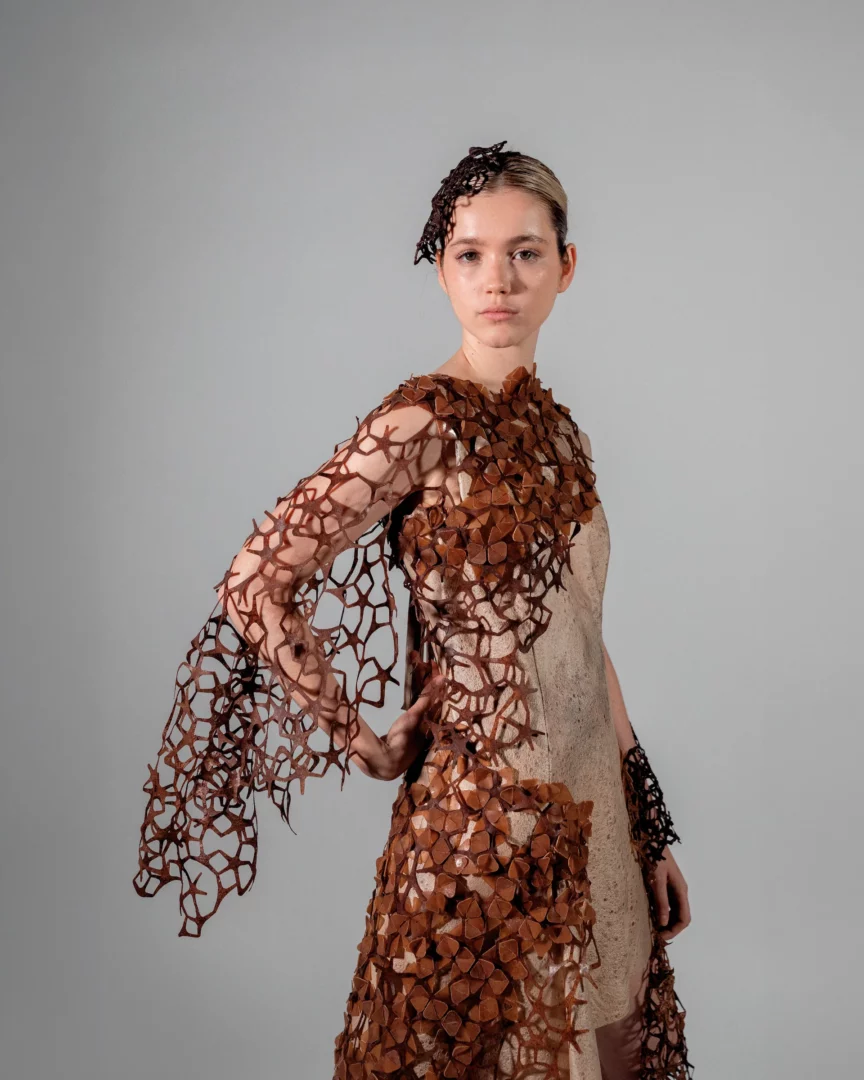
Can waste become a second skin? Cocoa Skin Dress turns cocoa husks — discards from chocolate production — into bio-based materials for contemporary fashion design.
Developed at the EcoBD Lab Research Group on the Creative Campus of Universidad Europea, Cocoa Skin Dress is a transdisciplinary project in which teaching researchers and students of art, design and fashion explore sustainable, experimental fashion. Its starting point is an unexpected material: cocoa husks donated by Kaicao Chocolate, an agri-food by-product that — guided by the principles of the circular economy and ecodesign — becomes a raw material with creative, functional and design value, able to speak the aesthetic language of contemporary fashion and to make an impact in exhibition, academic and publishing contexts.
Cocoa Skin Dress was created specifically for the CRUE Sustainability Sectoral Commission Conference, within the EcoBDLab research group at the Creative Campus of Universidad Europea. Its starting point is the metaphor of the three layers of human skin, translated into three bio-based material systems: biofoam, biofilm and biocomposite.
To investigate the potential of cocoa husks, an agri-food by-product donated by Kaicao, as a raw material for new biomaterials applied to fashion design.
To show that biomaterials can be built into structurally sound, functional and visually compelling designs that speak the language of contemporary fashion.
Garments and accessories that work on their own or together, with assemblies, layers and joints that allow the wearable surface to be configured in many ways.
To make an impact in exhibition, academic and publishing contexts, and to open up a conversation about circularity, biofabrication and the use of organic waste.
A base garment with qualities close to natural leather: flexible and enveloping. It acts as the structural support of the ensemble and the first layer to touch the body.
The most radical element of the project. An assemblable modular mesh structure, inspired by the cross-section of the cocoa husk, that creates a three-dimensional textile surface which can be configured in many ways.
Rigid, architectural pieces that add structure and formal contrast to the ensemble, exploring the sculptural possibilities of bio-based composites.
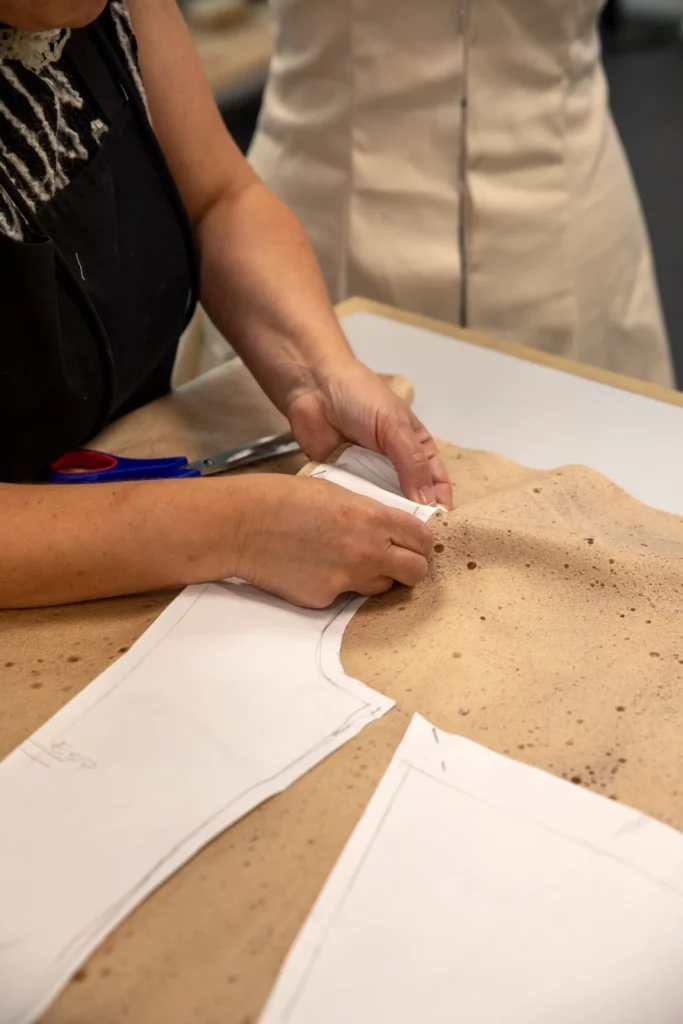
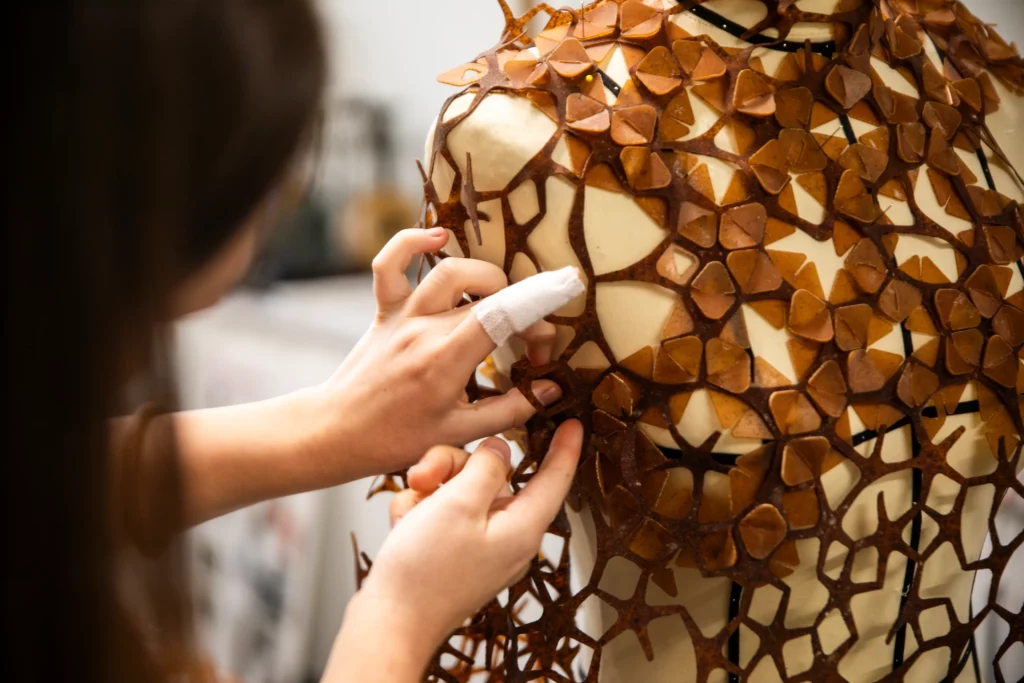
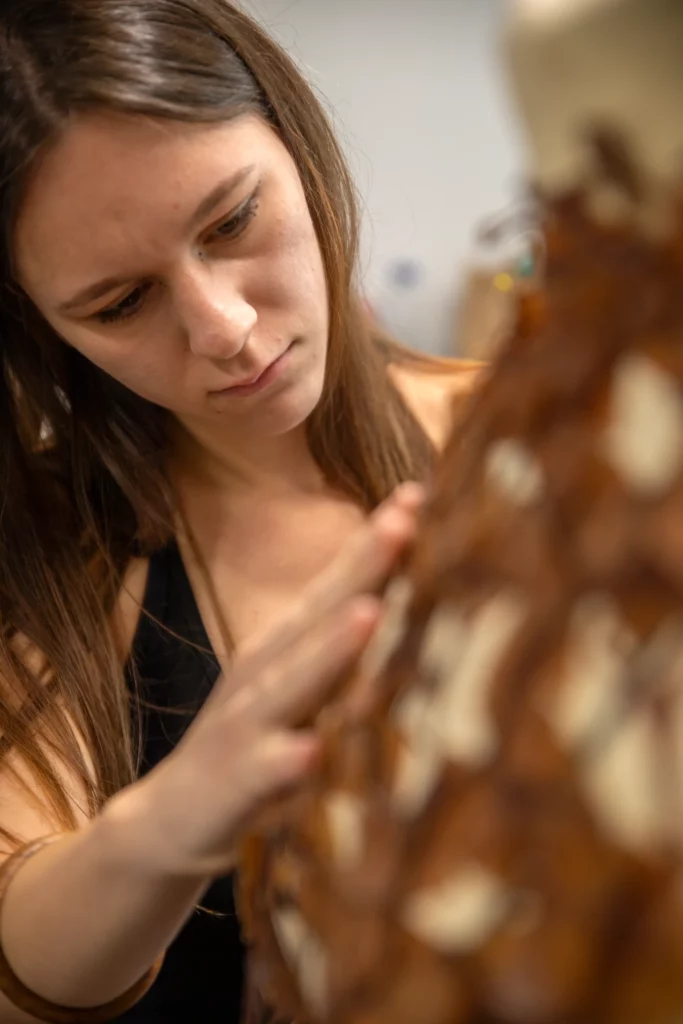
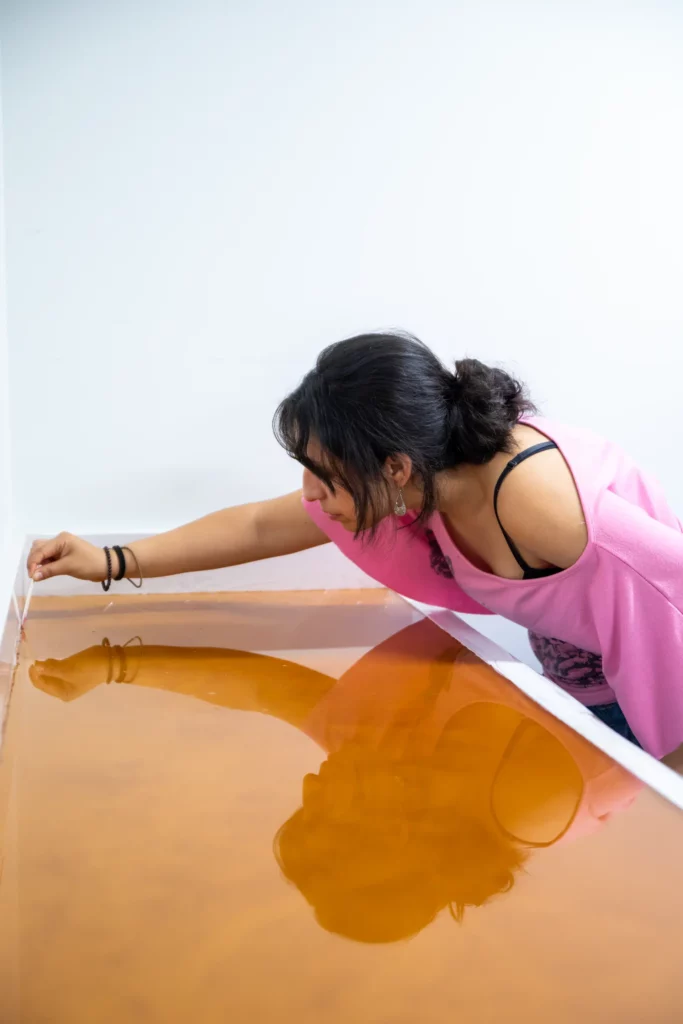
Kaicao is a bean-to-bar laboratory in Lavapiés, Madrid. It works with fine-flavour cocoa beans from single-origin estates — a category that accounts for barely 5% of world production — and makes its products by hand, with no added sugar. Roasting and winnowing the beans in its own laboratory produces a steady by-product: the husk. That material, donated to EcoBD Lab, is the raw material for the project's three biomaterials.
One industry's waste becomes another's resource: that is the circular economy off the page. Kaicao's cocoa takes an unlikely route — it enters the laboratory as a bean and leaves not only as chocolate but also, thanks to this collaboration, as a wearable surface.
Esther Pizarro Juanas
Principal investigatorVisual artist, researcher and professor at Universidad Europea de Madrid
Universidad Europea de Madrid

Miguel Trigo Morán
ResearcherLecturer and design researcher
Universidad Europea de Madrid
Silvia Gómez Cisneros
ResearcherSustainable design and circular innovation
Universidad Europea de Madrid
Coordination
Participating students
Model
Organised by: EcoBD Lab / Creative Campus UE In collaboration with: Kaicao
With the support of