


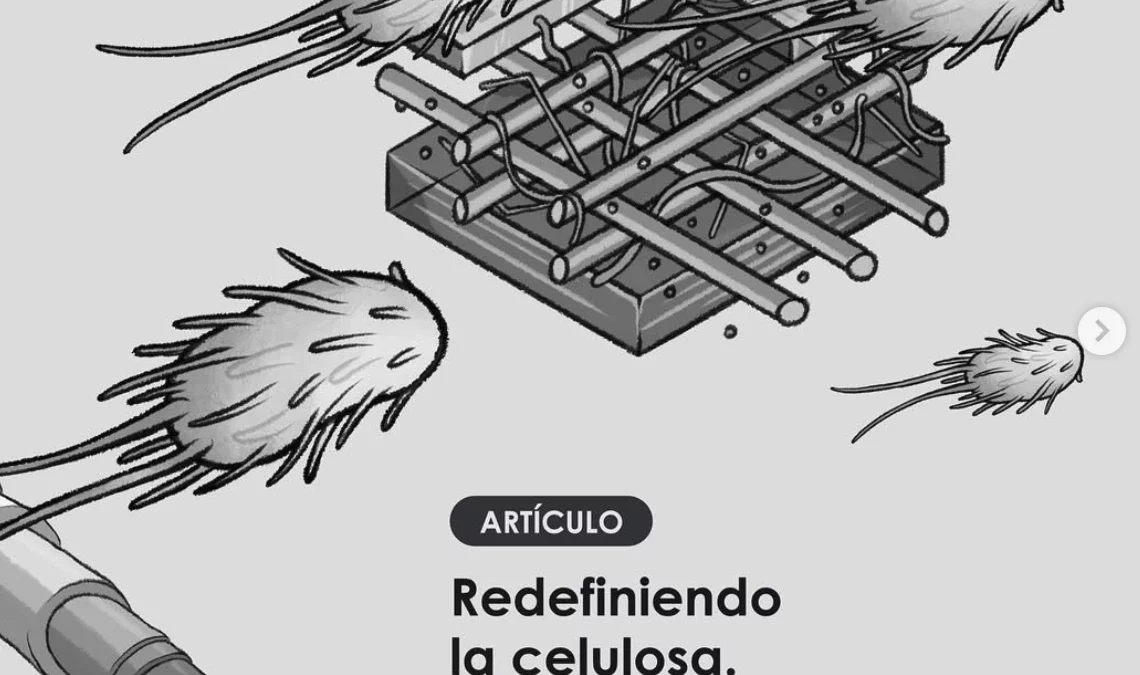
Redefiniendo la Celulosa. La rama verde de los nuevos materiales
Trigo, M. · 2025
Abstract
Cellulose, the most abundant biopolymer in nature, is present in plant cells and functions as a structural and defence network for plants, algae and even certain bacteria. This glucose chain requires other elements, such as binders, which enhance its mechanical and chemical properties, reaching society in the form of cotton, cardboard or paper. Cellulose biosynthesis represents a key axis in the survival and development of the plant kingdom, overcoming the biotic and abiotic factors to which plants are exposed: all types of mechanical stress, humidity, drought, predation and parasitism, among others. The degree of polymerisation and the presence and abundance of other chemical groups make it a versatile material that confers customisable properties. It represents a potential alternative to non-degradable synthetic materials, making use of cardboard and cotton waste from packaging and the fashion industry. The redesign of cellulose-based materials can add a further level to the circular economy of cotton and cardboard, enabling their use even at the domestic level.
The article reviews designers such as Nakao, with his production of fashion pieces, and projects from the Lausanne University of Art and Design, with advances achieved in the production of furniture and packaging. These designers create new high-performance biomaterials and show how they can be optimally and effectively integrated into the design workflow, through techniques such as nanofibrillation, digital fabrication and lamination. This work analyses issues relating to material implementation methods, new mechanisation processes, innovative methodological approaches, variations in the material matrix, cellulose sourcing and harvesting, and ecologically sustainable practices.
Authors

How to cite
Trigo Morán, M., & Curbelo Piñero, D. (2025). Redefiniendo la celulosa. La rama verde de los nuevos materiales. Cuadernos Del Centro De Estudios De Diseño Y Comunicación, (256). https://doi.org/10.18682/cdc.vi256.12189